AI Calorie Tracking: How It Works and How Accurate It Really Is
 Derek Clark · · Updated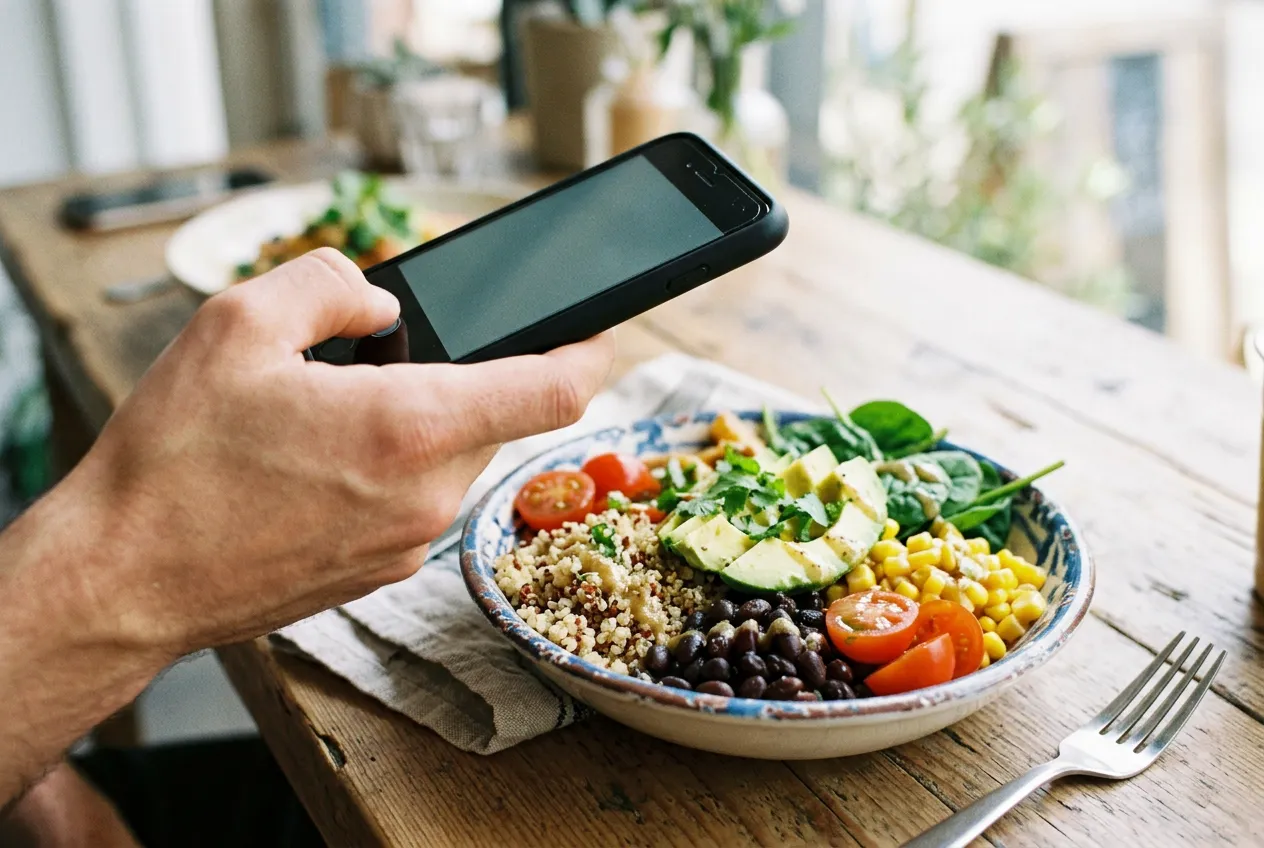
Snap a photo of your lunch. Two seconds later, an app tells you it’s 640 calories. That’s the promise of AI calorie tracking, and if your first reaction is skepticism, good. A camera guessing the calories in a burrito sounds like magic, and magic usually means marketing.
Except this time the technology is real. Imperfect, but real. So let’s break down how it actually works, where it’s accurate, where it falls apart, and the research finding that puts all of it in perspective: humans, including trained dietitians, are surprisingly bad at estimating calories too.
What AI Calorie Tracking Actually Is
AI calorie tracking means letting software identify your food and estimate its calories instead of doing all of it yourself. You take a photo (or describe the meal in a sentence), and the app figures out what you ate, how much of it there was, and what that adds up to in calories and macros.
Compare that to manual logging, where you search a database for “chicken breast, grilled, skinless,” pick from 40 nearly identical entries, guess your portion in grams, then repeat the whole dance for the rice, the broccoli, and the sauce. The data ends up in the same place either way. The difference is who does the work.
How the Technology Works
There are four steps under the hood, and knowing them explains why results are sometimes spot-on and sometimes way off.
Image recognition. A computer vision model trained on huge datasets of food photos looks at your image and identifies what’s in it. Chicken, rice, broccoli, a sauce. This part has gotten genuinely good. A 2024 study in the journal Nutrients tested seven AI photo logging apps and found the best ones correctly identified up to 97% of the food components across their test meals.
Language model reasoning. Newer apps layer a large language model on top of the vision system. Instead of just labeling objects, the LLM reasons about context. A beige mound next to teriyaki chicken is probably rice, not mashed potatoes. This layer is also what lets you type “two slices of pepperoni pizza from a local spot” and get a sensible estimate with no photo at all.
Database matching. Once the app decides what each food is, it matches it against a nutrition database (usually built on sources like USDA data) that stores calories and macros per gram. This step is mostly a solved problem. If the identification is right, the lookup is right.
Portion estimation. The hard part. The app has to figure out how much food is there from a flat 2D image. It uses cues like plate size, food height, and what’s around the food to estimate volume, converts volume to weight, then weight to calories. Every one of those conversions adds error, and this is where most of the inaccuracy in AI calorie tracking lives.
We dug into the practical side of this in our post on photo calorie tracking, but the short version is simple. Identifying the food is the easy 80%. Sizing the portion is the hard 20%.
Where It’s Genuinely Accurate
AI does well when food looks like what it is.
A banana. Two fried eggs. Grilled chicken with roasted potatoes. Standard restaurant items with predictable builds, like a cheeseburger or a burrito bowl. For meals like these, identification is nearly automatic and the portion guess has fewer ways to go wrong.
The research backs this up. A systematic review of 52 studies published in Annals of Medicine found that AI image-based systems averaged calorie errors ranging from as low as 0.1% to about 38% depending on the system and the food, with consistently better results on simple single-food images. The reviewers also noted something worth sitting with: AI accuracy fell within the same range as trained human assessors doing the same job. The software is roughly as good as people who estimate food intake for a living.
Where It Struggles
Now the honest part. Three weaknesses show up over and over.
Mixed dishes. Curries, casseroles, stews, stir-fries, anything where the ingredients blend together. The camera sees the surface, not the recipe. In that same Nutrients study, apps that handled simple foods well fell apart on mixed dishes. One app overestimated the calories in bibimbap by 270%. Several failed to identify the components of beef pho at all, underestimating it by as much as 76%.
Hidden fats. A tablespoon of olive oil is roughly 120 calories, and it’s invisible once it hits the pan. Restaurant kitchens use far more butter and oil than home cooks do, which is a big reason restaurant meals wreck everyone’s estimates. The AI can’t see what isn’t visible. Neither can you.
Sauces, dressings, and drinks. Is that yogurt dressing or ranch? Skim milk or whole in the latte? Small visual ambiguities carry 100-calorie swings. Liquids hide their ingredients completely, and depth is a problem too. A photo of a bowl shows the top layer, not how far down it goes.
Notice the pattern. AI is strong when calories are visible and weak when calories are hidden.
The Uncomfortable Part: People Are Worse
Whenever someone dismisses AI calorie tracking as inaccurate, ask the obvious follow-up. Compared to what?
In a well-known survey by the Center for Science in the Public Interest, more than 200 dietitians (actual nutrition professionals) were asked to estimate the calories in restaurant meals. They underestimated a 1,550-calorie hamburger and onion rings meal by an average of 685 calories. Experts. Off by nearly half.
Regular eaters don’t do better. A BMJ study of nearly 1,900 adults at fast food chains found people underestimated their meals by about 175 calories on average, and the bigger the meal, the bigger the miss. And in a classic New England Journal of Medicine study, people who insisted they couldn’t lose weight on 1,200 calories a day turned out to be eating around 2,000. They underreported their intake by 47% and overreported their exercise by 51%. Not lying. Just genuinely miscalibrated.
Even food labels have wiggle room. FDA rules allow the actual calorie content of packaged food to run up to 20% above what the label says. We covered that whole mess in why your calorie count is probably wrong, and the takeaway applies here too. No method hands you the true number, because a perfectly true number was never available. What matters is being consistently close.
When AI Beats Manual Logging (And When It Doesn’t)
Here’s the honest scorecard.
AI wins on anything you’d otherwise guess. Restaurant meals, takeout, a friend’s cooking, a homemade stir-fry with eight ingredients. Logging those manually means building the whole recipe entry by entry, or grabbing a random database match and hoping. A photo estimate you can quickly review beats both, and we’ve got a full guide on tracking calories when eating out if that’s your weak spot.
AI wins on consistency. The biggest failure mode in calorie tracking isn’t a bad estimate. It’s quitting. Manual logging takes a few minutes per meal, and that friction is exactly why so many people stop after two weeks. A skipped log isn’t 20% off. It’s 100% off. The method you’ll still be using in March beats the slightly more precise one you abandoned in January.
Manual wins on packaged food. If the item has a label or a barcode, scan it or type it in. The AI shouldn’t be guessing at a protein bar when the wrapper already tells you the answer, and every decent app lets you do both.
Manual wins when precision really matters. If you’re deep in a cutting phase or prepping for a physique competition, a food scale and weighed ingredients will always beat a camera. Most people aren’t doing that, and don’t need to.
For everyday tracking, the smart play is a hybrid. Photos for cooked meals, barcodes for packaged stuff, and a quick review of each estimate before you save it. Apps like AI Calorie Tracker let you adjust the portion or swap a misread ingredient after the photo, and that ten-second review is where most of the accuracy actually comes from.
The Bottom Line
AI calorie tracking identifies food about as well as trained humans do, estimates simple meals well, and struggles with the same things everyone struggles with: mixed dishes, hidden oils, and things it can’t see. The research says its errors sit inside the range of human expert error, and it demolishes manual logging on speed.
You’re not choosing between a flawed tool and a perfect one. You’re choosing between two flawed tools, and the one you’ll actually use every day wins.
FAQ
How accurate is AI calorie tracking?
It depends heavily on the food. A systematic review of 52 studies found average calorie errors ranging from under 1% on simple foods to around 38% on harder ones, which overlaps with the error range of trained human assessors. Simple, visible foods score best. Mixed dishes and hidden ingredients score worst.
Can AI count calories in mixed dishes like curry or casserole?
This is its weakest area. The camera sees the surface of a dish, not the recipe, so blended meals produce the largest errors in testing (one study found errors ranging from a 270% overestimate to a 76% underestimate on mixed dishes). You’ll get better results by reviewing the estimate and correcting obvious misses, like adding the oil or coconut milk the app can’t see.
Is AI calorie tracking better than logging food manually?
For restaurant meals, homemade dishes, and day-to-day consistency, usually yes, because it removes the friction that makes people quit tracking. For packaged foods with labels, or strict phases where you’re weighing everything on a food scale, manual entry is more precise. Most successful trackers use both.
Do I still need a food scale if I use AI calorie tracking?
Not for general awareness or moderate weight loss goals, where consistent estimates work fine. A scale becomes worth it when you’re trying to hit precise targets, or when you want to spot-check the app’s portion guesses on foods you eat often. Weighing your usual portions once or twice teaches you a lot about how good (or off) the estimates are.
Why does AI miss oils, butter, and sauces?
Because they’re visually hidden. A tablespoon of oil adds roughly 120 calories and disappears into the pan, and a creamy dressing looks nearly identical to a light one. No camera can detect what left no visual trace. If a meal was cooked in fat or covered in sauce, add it to the log yourself. That single habit fixes the biggest blind spot in photo-based tracking.

Derek Clark
Co-founder of Vima Fitness. Building simple, privacy-focused fitness apps for iPhone and Apple Watch since 2011. Runner, cyclist, and firm believer that fitness apps shouldn't need a tutorial.