How Many Calories Are in Thanksgiving Dinner? Dish by Dish
 Derek Clark
·
·
Updated
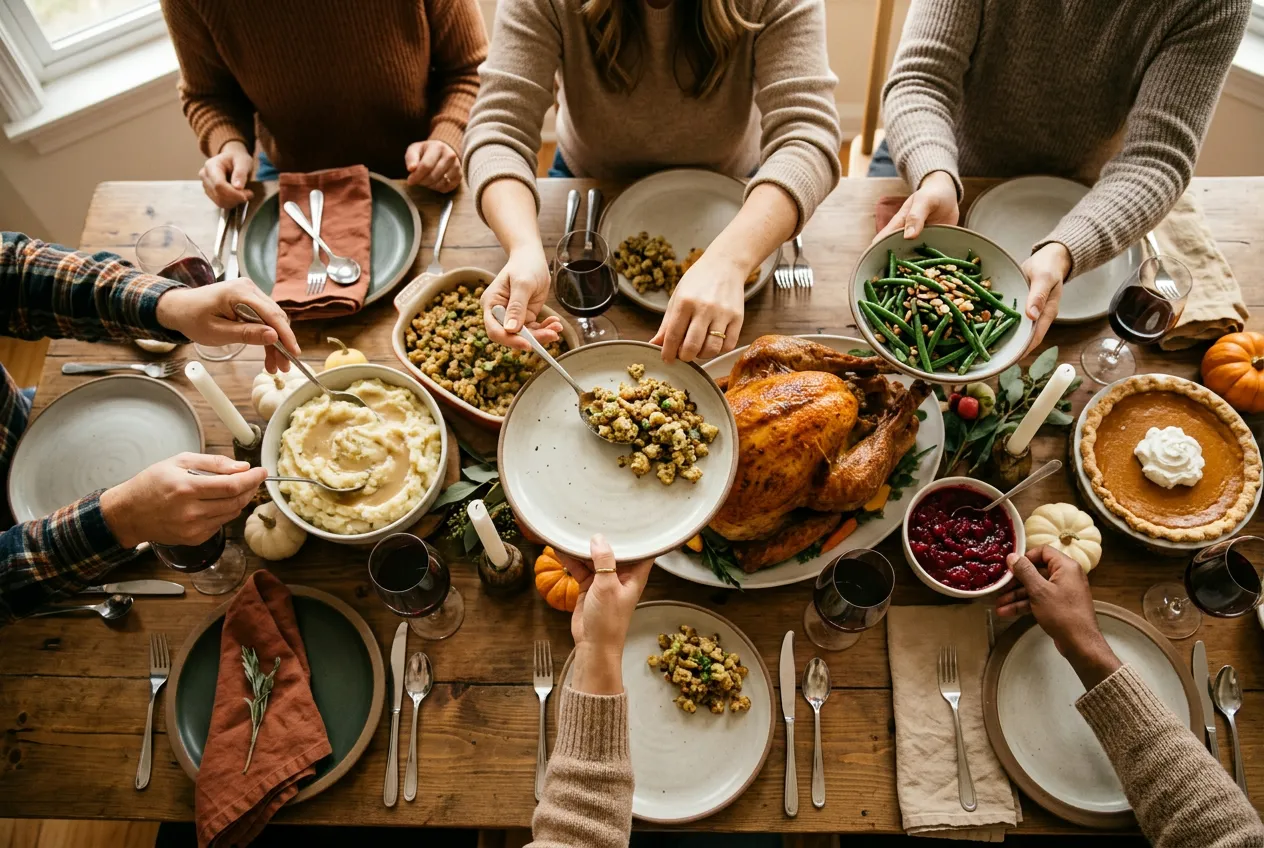
A typical Thanksgiving dinner plate (turkey, stuffing, mashed potatoes and gravy, cranberry sauce, green bean casserole, sweet potatoes and a buttered roll) comes to roughly 1,100 to 2,200 calories, based on USDA FoodData Central values. Where you land depends almost entirely on portion size. Add a slice of pie and a glass or two of wine and Thanksgiving dinner calories reach about 1,500 to 2,900. Across the whole day (appetizers, dinner, dessert, drinks and a leftover sandwich at night) it’s roughly 1,900 to 3,600 calories, before you count breakfast.
You’ve probably also heard that Americans eat 4,500 calories on Thanksgiving. That number gets repeated every November, but it’s an industry group’s estimate and runs higher than most careful tallies. Below you’ll find where it came from, a dish-by-dish table, and a few low-key ways to enjoy the day without turning dinner into a math problem.
Where the “4,500 calories on Thanksgiving” number comes from
The figure traces back to the Calorie Control Council, which ABC News described in 2014 as “the industry group for diet food companies.” Its estimate was about 3,000 calories at the meal plus another 1,500 from snacks and drinks across the day. That’s the 4,500. The council didn’t respond to ABC’s request for comment, and we couldn’t find the estimate or any methodology behind it on the council’s current website.
Other people have run the numbers since, and they mostly come in lower:
- New York Times health reporter Tara Parker-Pope tried to build the most calorie-heavy Thanksgiving dinner she could in 2012 and got to 2,486 calories, according to the same ABC report.
- The American Council on Exercise’s chief science officer, Cedric Bryant, told ABC that 4,500 for the day may be “liberal,” but 3,000 at the meal is plausible. His sample dinner (8 ounces of dark meat, two kinds of pie, marshmallow sweet potatoes) totaled 3,170.
- Consumer Reports’ test kitchen plated a full dinner using USDA standard servings, including a glass of wine and a slice of pumpkin pie, and it came to 1,753 calories.
So 4,500 isn’t impossible for a big eater who grazes all day. It just isn’t a typical or well-documented number.
Thanksgiving dinner calories, dish by dish
Here’s what the classic dishes add up to. Calories come from USDA FoodData Central entries (the FNDDS survey foods, plus SR Legacy for the homemade pies), scaled to each portion using USDA’s own gram weights.
| Dish | Modest serving | Calories | Generous serving | Calories |
|---|---|---|---|---|
| Roast turkey, light and dark meat, skin on | 3 oz | 156 | 6 oz | 311 |
| Bread stuffing | 1/2 cup | 177 | 1 cup | 354 |
| Mashed potatoes (made with milk) | 1/2 cup | 142 | 1 cup | 285 |
| Gravy | 1/4 cup | 29 | 1/2 cup | 58 |
| Cranberry sauce | 1/4 cup | 111 | 1/2 cup | 223 |
| Green bean casserole | 1/2 cup | 64 | 1 cup | 129 |
| Candied sweet potatoes | 1/2 cup | 234 | 1 cup | 468 |
| Dinner roll with butter | 1 roll, 1 pat | 172 | 2 rolls, 2 pats | 344 |
| Dinner plate total | 1,085 | 2,172 | ||
| Mac and cheese | 1/2 cup | 256 | 1 cup | 513 |
| Pumpkin pie, homemade | 1/8 of a 9-inch pie | 316 | 1/6 of a 9-inch pie | 422 |
| Pecan pie, homemade | 1/8 of a 9-inch pie | 503 | 1/6 of a 9-inch pie | 670 |
| Whipped cream (canned) | 2 tbsp | 15 | 1/4 cup | 39 |
| Red wine | 1 glass (5 fl oz) | 128 | 2 glasses | 255 |
| Cheese and crackers | 1 oz cheddar, 5 crackers | 182 | 2 oz cheddar, 10 crackers | 364 |
| Leftover turkey sandwich | 1 regular | 217 | 1 large | 331 |
The plate total covers the first eight rows. Add pumpkin pie with whipped cream and wine and you get the 1,544 to 2,888 range from the top of this post. Add the cheese board and the late-night sandwich and it’s 1,943 to 3,583.
How portion size swings the total
Look at the two columns again. Same table, same dishes, and the generous plate is twice the modest one. Nothing on the menu changed. Only the spoon did.
A few dishes move the number more than others:
- The sweet stuff on the plate. Candied sweet potatoes and cranberry sauce are sides, but between them they can add almost 700 calories at generous portions. That’s more than the turkey.
- Which pie you pick. A slice of homemade pecan pie runs about 190 calories more than the same size slice of pumpkin.
- Turkey skin, a little. USDA puts 3 ounces of light meat at about 144 calories with skin and 118 without. Real, but small. Dark meat with skin is about 172.
- Drinks. Each glass of wine is around 128 calories, and nobody counts the second one.
There’s also a gap between “USDA standard” and how your family actually cooks. Plenty of holiday recipes use more butter, cream and sugar than the database averages, and every tablespoon of butter stirred into the potatoes adds roughly 100 calories (USDA lists a tablespoon at 104).
Does one big Thanksgiving meal actually matter?
Probably less than you’d think. The often-repeated claim is that people gain 5 pounds over the holidays. When researchers actually weighed 195 adults before, during and after the season, the average holiday gain was 0.37 kg, under a pound, according to the study in the New England Journal of Medicine.
The catch, which the same researchers pointed out, is that this small gain didn’t come back off in spring or summer. So it’s the six weeks of leftovers, parties and cookie tins that add up over the years, not one Thursday. Enjoy the meal. Then go back to normal on Friday.
If you’re managing diabetes, heart disease or another condition where a heavy meal matters, a quick check-in with your doctor or a registered dietitian before the holiday is worth it.
Easy ways to enjoy Thanksgiving dinner (no willpower required)
Start your plate with the vegetables
Order seems to matter a little. In a Penn State study of 42 women, eating a large, low-calorie salad before the main course cut total calories at the meal by about 12%, while a cheesy, heavily dressed salad increased them. Translation for Thursday: put the green beans or a simple salad on your plate first, eat some of it, then go for the stuffing. You’ll still have stuffing. Probably just a bit less.
Don’t skip breakfast to “save up”
It feels logical, but it backfires for a lot of people. As a Consumer Reports dietitian put it in that same article, “If you’re ravenous when the main event begins, you’re even more likely to overeat.” A normal breakfast keeps the 3 p.m. version of you from inhaling the cheese board.
Take a walk after the meal
A short, easy walk after a big meal is one of the simplest things you can do. In a small 2025 study, a 10-minute walk at a comfortable pace right after a sugary drink lowered the blood sugar peak in healthy young adults. It’s also a great excuse to get away from the dishes. Here’s more on what a short walk after eating does for blood sugar and digestion. And if you’re lining up for a race that morning, our turkey trot training plan will get you to the start line ready.
Pick your favorites, skip the “fine” dishes
You don’t need a spoonful of everything. If the dinner rolls are store-bought and you can take or leave them, leave them, and spend those calories on the pie you’ve been thinking about since Halloween.
How to estimate homemade and restaurant-style dishes
Database values are averages. Your aunt’s sweet potato casserole is not average. To get closer:
- Homemade dishes: add up the main ingredients for the whole pan, then divide by the number of servings. It sounds like a lot, but it takes five minutes, and our guide on how to count calories in homemade meals walks through it.
- Restaurant or catered dinners: assume bigger portions and more fat than a home recipe, and round up.
- Watch the usual suspects: butter, cream, oil, gravy and sugar are where most of the surprise calories hide. These are the hidden calories nobody tells you about, and holiday food is full of them.
If you’d rather not measure anything on a holiday (fair), photo logging is an option. With an app like AI Calorie Tracker, you snap your plate and get an estimate you can adjust. It won’t be perfect, and neither is guessing; here’s an honest look at whether photo calorie tracking actually works.
Frequently Asked Questions
How many calories are in a Thanksgiving plate of food?
A typical plate with turkey, stuffing, mashed potatoes and gravy, cranberry sauce, green bean casserole, sweet potatoes and a buttered roll has about 1,100 calories at modest portions and about 2,200 at generous ones, based on USDA FoodData Central values. Pie, whipped cream and wine add another 460 to 720.
Do people really eat 4,500 calories on Thanksgiving?
Some might, but it isn’t a reliable average. The 4,500 figure comes from the Calorie Control Council, an industry group, and we couldn’t find a published method behind it. Independent tallies of a full dinner have landed between about 1,750 and 3,200 calories.
How many calories are in a slice of pumpkin pie vs pecan pie?
Using USDA values for homemade pie, a slice that’s 1/8 of a 9-inch pie has about 316 calories for pumpkin and about 503 for pecan. A tablespoon or two of canned whipped cream adds only 8 to 15.
Will one Thanksgiving dinner make me gain weight?
One meal won’t undo anything. A study in the New England Journal of Medicine found the average gain over the whole holiday season was under a pound. The bigger issue is that the small gain tends to stick, so getting back to normal habits after the holiday matters more than the meal itself.
The bottom line
Thanksgiving dinner is a big meal: roughly 1,100 to 2,200 calories for the plate and up to around 3,600 for the whole day of holiday food, depending on portions. That’s not the 4,500 you keep hearing, and it’s one day. Fill your plate with the dishes you actually love, start with something green, take a walk after, and get back to your usual routine on Friday.

Derek Clark
Co-founder of Vima Fitness. Building simple, privacy-focused fitness apps for iPhone and Apple Watch since 2011. Runner, cyclist, and firm believer that fitness apps shouldn't need a tutorial.