Weighted Vest Walking: How Much Weight and Who Should Skip It
 Derek Clark
·
·
Updated
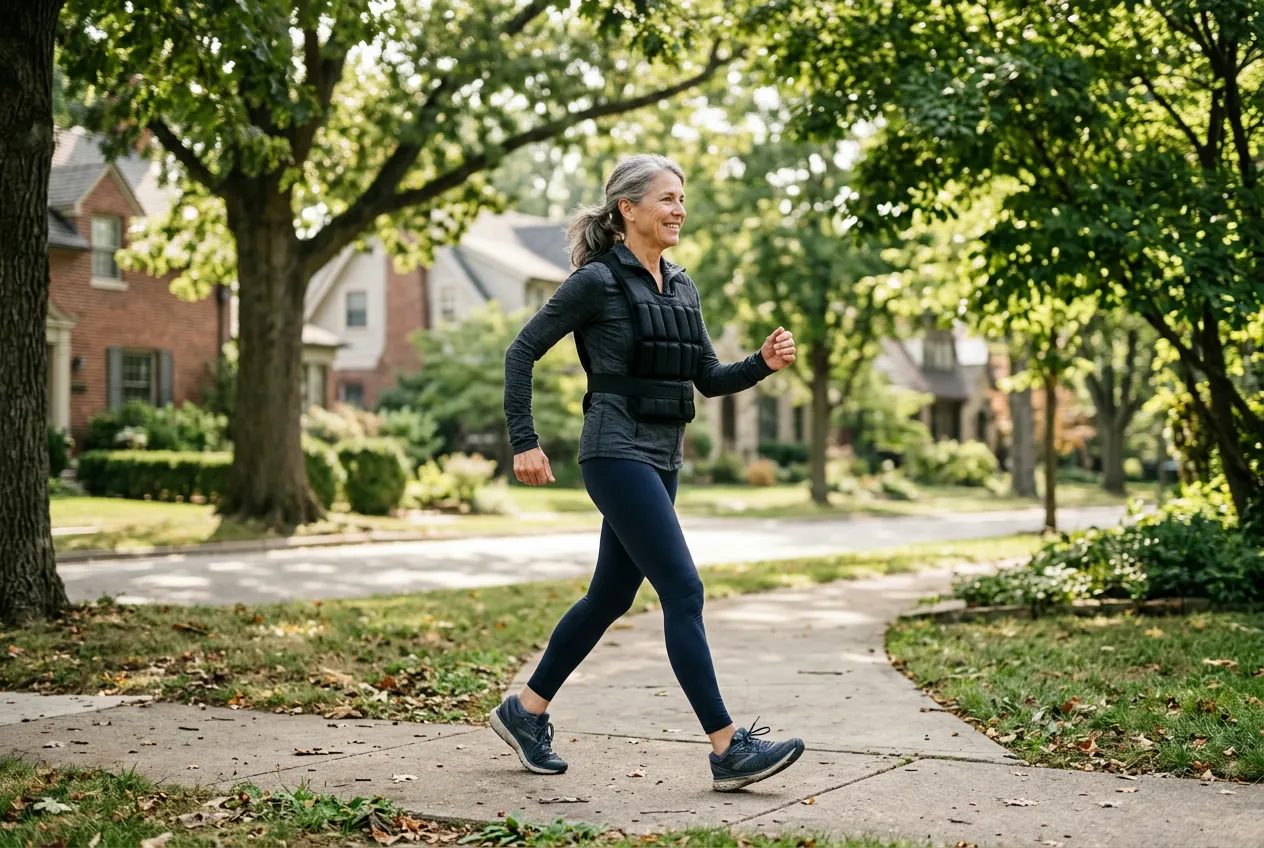
Weighted vest walking makes an ordinary walk a bit harder, and that’s really the whole idea. You get a modest calorie bump and more load running through your legs and bones with every step. For weight, Cleveland Clinic suggests a vest that’s 5 to 10% of your body weight, which is about 7.5 to 15 pounds if you weigh 150. The bigger promises you’ve seen online (stronger bones, melting fat) are a lot shakier.
Here’s what the research actually says, how a vest compares to rucking, how to pick one that fits, a 4-week plan to ease in, and who should talk to a doctor before strapping one on.
Does walking with a weighted vest burn more calories?
More weight means more work. The question is how much.
Texas A&M AgriLife Extension’s Howdy Health program summarized two small studies: walking in a vest equal to 15% of body weight raised calorie burn by about 12%, and a vest at 10% of body weight on an inclined treadmill raised it by about 13%. In real terms, a 30-minute walk at 3 mph that burns 120 to 168 calories might pick up an extra 15 to 22 calories. That’s a few bites of a granola bar. Nice, not life-changing.
The more interesting finding is about effort. In a 2006 treadmill study of 10 young adults wearing vests at 10, 15 and 20% of body mass, the vest raised oxygen use at every speed, but it only pushed up relative intensity (how hard the walk was compared with each person’s capacity) at the faster speeds. At a slow stroll, that difference didn’t show up. The vest also increased the forces going through the legs with each step, which is the whole theory behind using vests for bone health.
So a vest earns its keep on a brisk walk. On a slow amble it adds a bit of work but not much challenge. For the baseline numbers by weight and pace, see our guide on how many calories walking burns.
Does a weighted vest build bone density? What the studies show
This is where the internet gets ahead of the evidence. The honest answer is “sometimes, alongside exercise, and less than you’d hope.”
Just wearing a vest isn’t enough. In a 27-week randomized trial of 62 older adults (average age 74), people wore a vest of 3 or 5% of body weight for 2 hours a day, 4 days a week, with no exercise required. Strength, physical performance and bone turnover markers didn’t budge, and the researchers concluded the dose was too small.
A vest didn’t stop bone loss during weight loss. The INVEST in Bone Health trial, published in JAMA Network Open in 2025, followed 150 older adults (average age 66, about three quarters women) with obesity who lost around 10% of their body weight over a year. One group wore a vest about 7 hours a day, replacing roughly 78% of the weight they’d lost. Every group lost hip bone density (1.2% to 1.9%), and the vest group did no better than diet alone. Supervised strength training didn’t prevent it either.
Vest plus exercise beats doing nothing. A 2026 meta-analysis in Osteoporosis International pooled 9 randomized trials with 368 middle-aged and older adults. Vest-loaded exercise improved bone density at the hip and lower spine compared with usual activity. But adding a vest to an exercise program showed no clear extra bone benefit over the exercise alone (only one trial tested that), though it did add about 0.73 kg (roughly 1.6 pounds) more fat loss. The authors rated certainty for most bone outcomes as low to moderate.
The exercise does most of the work. A vest is a way to add load to a walk, not a bone treatment, and no substitute for your doctor’s plan if you have low bone density.
How heavy should a weighted vest be?
That 5 to 10% range comes from Cleveland Clinic sports medicine specialist Jessica Tomazic, MD, and the clinic says going heavier offers little extra benefit and raises your injury risk. Start at the low end.
| Your body weight | 5% (starting point) | 10% (upper end) |
|---|---|---|
| 120 lb | 6 lb | 12 lb |
| 150 lb | 7.5 lb | 15 lb |
| 180 lb | 9 lb | 18 lb |
| 210 lb | 10.5 lb | 21 lb |
| 240 lb | 12 lb | 24 lb |
Vests come in fixed sizes or with removable weights, so round down. If you’re already carrying extra body weight, your joints are working hard on every walk, so start near 5% and stay there a while.
Weighted vest vs. rucking: what’s the difference?
The difference is where the weight sits.
A vest hugs your torso and splits the load between your chest and back, close to your center of gravity, so it’s easier to stay upright. A rucksack puts everything behind you, which tends to tip you into a slight forward lean to compensate. Ruckers also tend to carry heavier loads over longer distances.
A vest suits lighter loads on everyday walks. A pack suits heavier loads and hike prep, and you probably already own one. If that sounds more like you, our rucking for beginners guide covers how to load it and build up.
How to choose and fit a weighted vest
Cleveland Clinic’s advice is simple: a vest that fits securely and is made from breathable material. A few other things make a big difference:
- Adjustable weight. Small removable weights let you add a little at a time instead of jumping 5 pounds.
- Balanced front and back. The vest shouldn’t drag you forward or back.
- No bounce. Walk briskly and jog a few steps in place. If it shifts or slaps, tighten it or try another design.
- Room to breathe. Take a deep breath and raise your arms overhead. Straps shouldn’t dig into your neck or squeeze your ribs.
A 4-week weighted vest walking plan
The first month is about letting your joints, back and feet adapt, not seeing how much you can carry. The Howdy Health guide recommends starting with just 10 to 15 minutes in the vest. Keep a rest day between vest walks and leave your other walks unweighted.
| Week | Vest weight | Time in the vest | Vest walks per week |
|---|---|---|---|
| 1 | About 5% of body weight | 10 to 15 minutes, then take it off and finish your walk | 2 |
| 2 | About 5% | 20 minutes on flat ground | 3 |
| 3 | About 5% | 30 minutes, add a gentle hill or two | 3 |
| 4 | Add 2 to 3 lb (toward 7 or 8%) | Drop back to 20 minutes, then build toward 30 | 3 |
If anything aches the next day, repeat the week instead of moving on. One handy check: walk the same route with and without the vest and compare your pace in Vima Walk. If your pace falls off a cliff or your stride shortens a lot, the vest is too heavy for now.
Posture and joint cautions
A vest only helps if you can walk normally in it. If you can’t, it’s too heavy.
- Stand tall. Head up, shoulders relaxed, no forward lean. If you catch yourself hunching, take weight out.
- Keep your normal stride. Don’t overstride to keep pace. Shorter, quicker steps are fine.
- Stick to walking at first. Dr. Tomazic cautions against wearing a vest for biking or anything fast or balance-heavy when you’re new to it, because it can throw off your balance.
- Respect your joints. More load per step means more force through your feet, knees and hips. Mild soreness that fades in a day is normal. New or lingering joint pain means stop and back off.
- Watch the heat. A vest traps heat, so summer vest walks run hotter.
Who should skip a weighted vest (or ask a doctor first)
Mass General Brigham advises skipping weighted vests if you have neck, shoulder or back pain, joint problems in your hips, knees or ankles, or heart conditions such as heart disease or high blood pressure. A medically reviewed guide from Midi Health adds that the extra weight puts pressure on your pelvic floor, and recommends checking with a clinician first if you have leakage, prolapse or recent childbirth, are pregnant or trying to conceive, or have osteoporosis.
Talk to your doctor before trying a vest if any of these apply:
- Back, neck or shoulder pain, including disc problems
- Knee, hip or ankle arthritis, or a recent joint injury
- Pelvic floor symptoms (leaking, heaviness, prolapse) or a recent birth
- Pregnancy
- Heart disease, high blood pressure or any heart condition
- Osteoporosis or a past fracture
- Balance problems or recent falls
Skipping the vest doesn’t mean skipping the benefits. Hills, a faster pace and some strength work all add load without one.
Frequently Asked Questions
How heavy should a weighted vest be for walking?
Most guidance lands on 5 to 10% of your body weight, and Cleveland Clinic says going heavier offers little extra benefit. Start near 5% (about 7.5 pounds if you weigh 150), wear it for part of your walk, and add weight only once your normal posture and stride feel easy.
How many more calories does a weighted vest burn?
Not many. Small studies show roughly 12 to 13% more calories at the same pace, about 15 to 22 extra calories on a typical 30-minute walk. The vest makes the biggest difference at brisk speeds, and walking faster or adding hills boosts the burn too.
Can a weighted vest improve bone density?
Possibly, as part of an exercise program. A 2026 meta-analysis found vest-loaded exercise improved hip and spine bone density compared with usual activity. But wearing a vest without exercise didn’t help older adults in one trial, and in a 2025 trial a vest didn’t prevent hip bone loss during weight loss.
Is a weighted vest better than rucking?
Neither is better overall. A vest spreads the weight around your torso, which suits lighter loads on everyday walks. A rucksack suits heavier weights and hike prep. Pick the one you’ll actually use.
The bottom line on weighted vest walking
A weighted vest is a simple way to make a walk a little harder. You’ll burn a few more calories and load your legs and bones more, especially at a brisk pace. It just won’t fix your bones by itself.
Start around 5% of your body weight, wear it for part of your walk, and build slowly. If you’ve got back, knee, pelvic floor or heart issues, or you’re pregnant, check with your doctor first. And if the vest ends up in the closet after a month, that’s fine. The walking is what matters, and our walking for weight loss guide has plenty of ways to keep making progress without one.

Derek Clark
Co-founder of Vima Fitness. Building simple, privacy-focused fitness apps for iPhone and Apple Watch since 2011. Runner, cyclist, and firm believer that fitness apps shouldn't need a tutorial.