Walking at Night: Is It Safe and How to Be Seen by Drivers
 Derek Clark
·
·
Updated
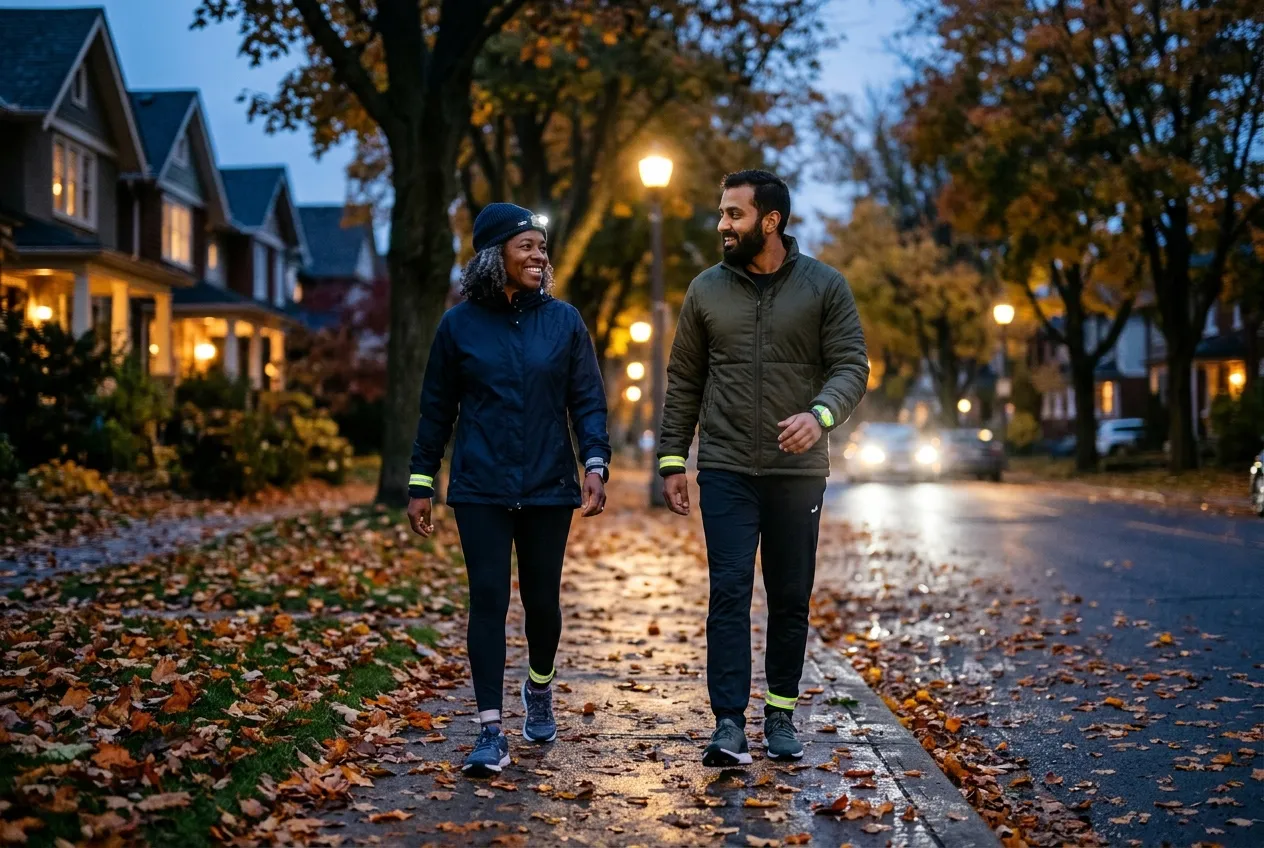
Walking at night is safe enough for most people, but only if drivers can see you, and they see a lot less than you’d think. In 2024, 76% of US pedestrian deaths happened in the dark, according to NHTSA. The best fix isn’t a brighter jacket. It’s retroreflective material on the parts of you that move (ankles, knees, wrists), a light up front, and a route with sidewalks.
That matters right now. Daylight saving time ended on November 1, so the after-work walk that used to finish at sunset now starts in full dark. Below is what the crash data actually says, why drivers miss pedestrians, the gear that works, how to pick a route, personal safety basics, how to see the ground, and whether a late walk messes with your sleep.
Is it safe to walk at night?
Mostly yes, with one big asterisk: traffic. NHTSA’s 2024 pedestrian fact sheet counts 7,080 pedestrians killed in US traffic crashes. Three out of four died in the dark, compared with 20% in daylight. Most of those deaths (73%) happened away from intersections, which is where drivers least expect someone on foot.
The trend isn’t great either. The Governors Highway Safety Association reports that fatal pedestrian crashes at night rose 84% between 2010 and 2023, compared with 28% for daytime deaths. And 65% of pedestrian deaths in 2023 happened in places with no sidewalk.
Timing is the part most walkers never hear about. NHTSA breaks pedestrian deaths down by season and hour, and the deadliest window slides earlier as the days get shorter.
| Season | Deadliest 3-hour window | Share of that season’s pedestrian deaths |
|---|---|---|
| Winter (Dec, Jan, Feb) | 6 to 8:59 p.m. | 33% |
| Fall (Sep to Nov) | 6 to 8:59 p.m. | 29% |
| Spring (Mar to May) | 9 to 11:59 p.m. | 28% |
| Summer (Jun to Aug) | 9 to 11:59 p.m. | 32% |
So in fall and winter, the riskiest stretch of the day lines up almost perfectly with the post-dinner walk. Across the whole year, 6 to 9 p.m. was the deadliest window, with 24% of deaths.
The clock change shows up in the numbers too. An Insurance Institute for Highway Safety analysis of 2010 to 2019 crashes found fatal pedestrian and bicyclist crashes rose 13% in the five weeks after the fall time change, and the researchers tied that rise to the change in light. Older work from the University of Michigan, using the same time change as a natural experiment, found some pedestrian crash scenarios carry up to seven times more risk in the dark than in daylight.
None of that means you should stop walking after dark. It means a night walk needs a different setup than a daytime one.
Why drivers don’t see you (even when you think they do)
Here’s the uncomfortable part. You can see the car just fine. Its headlights are pointed right at you. So it’s natural to assume the driver can see you too.
Often they can’t. In a closed-road experiment from Clemson and Queensland University of Technology, pedestrians on the shoulder pressed a button when they believed an approaching driver could first see them. They overestimated their own visibility and dramatically underestimated how much reflective gear helps.
The driver’s side of the research is even more sobering. In a study of 20 drivers on a closed circuit at night, drivers recognized only 5% of pedestrians in the hardest condition: black clothing, low beams, and glare from oncoming lights. Even without glare, older drivers on low beams had an average recognition distance of zero for a pedestrian in black. They didn’t pick them out at all. But when pedestrians wore retroreflective strips placed to show their movement, drivers recognized every one of them (no glare), and younger drivers on high beams spotted them from 220 meters (722 feet) away.
A review of this research adds two more problems. Drivers routinely “overdrive” their headlights, meaning they go faster than they could stop within the distance their lights reach, and they underuse high beams. Plan your walk as if every driver will notice you late, because a lot of them will.
How to be visible walking at night
Three things make a pedestrian visible after dark. Bright clothing isn’t really one of them.
Retroreflective beats bright colors. A Cochrane review of 39 trials found fluorescent yellow, orange and red improve detection in the daytime. At night, the things that helped were lamps, flashing lights and retroreflective materials. Fluorescent fabric is a daylight tool. Retroreflective material sends a car’s headlight beam back toward its source (the driver’s eyes), so a thin reflective strip does more after dark than a neon jacket.
Put the reflective stuff on what moves. This is the “biomotion” effect. Reflective markings on your joints trace the motion of a walking body, which helps a driver’s brain read the shape as a person instead of a mailbox or a sign. The same review found markings on the extremities (ankles, knees, wrists, elbows) work better than reflective material on the torso, like a vest. A vest says “something is there.” Moving ankle bands say “that’s a person walking.”
Carry a light. NHTSA’s own advice is to “wear reflective materials or use a flashlight at night.” Reflective gear only works once headlights hit it. A headlamp or chest light makes you visible on its own, and it lights your path.
Here’s a simple night kit.
| Item | Where it goes | What it does |
|---|---|---|
| Reflective ankle bands | Both ankles | Makes your walking motion obvious in headlights |
| Reflective wrist bands or gloves | Both wrists | Adds your arm swing to the pattern |
| Headlamp or clip-on light | Head or chest, facing forward | Shows oncoming drivers you’re there and lights the ground |
| Small flashing light | Back of a jacket or pack | Covers cars coming up behind you at crossings and turns |
| Reflective vest (optional) | Torso | Fine as an extra, weak on its own |
One honest caveat. The Cochrane authors found no trials that measured actual crashes, only how quickly drivers detect and recognize pedestrians. But being recognized hundreds of feet away instead of not at all is a pretty convincing reason to buy a pair of ankle bands.
How to choose a safer route for walking at night
Gear helps drivers see you. Your route decides how many drivers you have to deal with in the first place.
- Use sidewalks and paths. If there isn’t one, NHTSA says walk on the shoulder, facing traffic, so you see what’s coming and can step off the road. Given that 65% of pedestrian deaths happen where there’s no sidewalk, a longer route with sidewalks is worth the extra minutes.
- Cross where drivers expect you. Crosswalks and intersections first. If there isn’t one, NHTSA’s advice is to find a well-lit spot and wait for a gap big enough that you don’t have to hurry.
- Pick lit, familiar streets. Walk your night loop once in daylight so you know where the broken curbs, driveways and dark stretches are.
- Make eye contact before you step out. Never assume a turning driver has seen you. Wait for the nod or the wave.
- Keep your ears open. NHTSA specifically warns against devices that take your eyes and ears off the road. One earbud at low volume, or none.
- Skip the walk after a few drinks. In 27% of fatal pedestrian crashes in 2024, the pedestrian who died had a blood alcohol level of .08 or higher.
Walking the dog? Same rules, plus a lighted collar or reflective leash so drivers see the dog too. If that walk doubles as your workout, here’s how to turn dog walks into real exercise without dropping any of these habits.
Personal safety basics for walking after dark
Traffic is the best-documented risk, but it isn’t the only thing people worry about at night. Feeling safe is a big part of whether you’ll keep walking, so cover the basics.
- Tell someone your route and when you expect to be back, or share your location with them from your phone.
- Carry your phone, charged, in a zipped pocket.
- Walk with a friend, a group or the dog when you can.
- Stick to busy, lit streets instead of shortcuts through empty lots or unlit trails.
- Trust your gut. Crossing the street or heading home early costs you nothing.
- Keep your eyes up. Checking a screen while you walk pulls your attention off the street and the people on it.
If you track your walks with Vima Walk, its Apple Watch app can start, pause and save a walk without the iPhone, so the phone can stay zipped away while your eyes stay on the street.
Seeing where you’re going: headlamps and uneven ground
Visibility works both ways. Drivers need to see you, and you need to see the ground. Streetlights leave dark gaps between poles, and fall and winter add wet leaves, acorns, heaved sidewalk slabs and, once it freezes, black ice that looks exactly like wet pavement.
- Angle a headlamp down so the beam lands a few steps ahead of you. A handheld flashlight works too, but a headlamp leaves both hands free for balance.
- Shorten your stride on wet or unfamiliar ground. Night isn’t the time to chase your fastest pace.
- Stick to routes you know, and look for the curb at every crossing.
- Watch for ice after a freeze. Our guide to walking in cold weather covers traction devices and how to walk on ice without going down.
Does walking at night affect your sleep?
Probably not, and it may even help. A 2019 meta-analysis of 23 studies found that evening exercise didn’t hurt sleep in healthy adults. If anything, the effect leaned positive, with slightly more deep (slow-wave) sleep. The exception was vigorous exercise ending an hour or less before bedtime, which may make it harder to fall asleep and cut total sleep.
A brisk walk is moderate exercise for most people, not vigorous. So the rule is simple. If you push the pace, finish at least an hour before bed. If it’s an easy stroll, don’t worry about it. For more on timing, see the best time to walk for sleep, energy or weight loss.
Frequently Asked Questions
Is it safe to walk alone at night?
It can be, if you plan for traffic first. In 2024, 76% of US pedestrian deaths happened in the dark, so wear reflective bands on your ankles and wrists, carry a light, use sidewalks, and walk facing traffic where there aren’t any. For personal safety, stick to lit, busy routes, carry a charged phone and tell someone where you’re going.
What should I wear to be visible walking at night?
Retroreflective material on your ankles, knees and wrists, plus a headlamp or clip-on light. Research on drivers at night shows reflective markings on moving joints are recognized sooner than reflective material on the torso, such as a vest. Bright or fluorescent colors help in daylight but do little after dark.
Should you walk with or against traffic at night?
Use a sidewalk or path whenever there is one. If there isn’t, NHTSA advises walking on the shoulder facing traffic, so you can see oncoming cars and step aside. Cross at crosswalks or intersections, where drivers expect pedestrians.
What time is most dangerous for pedestrians?
In NHTSA’s 2024 data, 6 to 9 p.m. was the deadliest window of the year, with 24% of pedestrian deaths. In the winter months that same window accounted for a third of pedestrian deaths, right when a lot of people take an after-dinner walk.
Does walking at night keep you awake?
Usually not. A meta-analysis of 23 studies found evening exercise didn’t harm sleep in healthy adults, though vigorous exercise ending within an hour of bedtime may delay sleep. An easy or brisk walk finished an hour before bed is fine for most people.
The bottom line on walking at night
Walking at night doesn’t have to be risky. Assume drivers can’t see you, then fix that: reflective bands on your ankles and wrists, a light up front, sidewalks or facing traffic, crosswalks, and ears open. Pick lit routes you know, tell someone where you’re going, and finish hard walks an hour before bed.
The dark evenings are here until March. Your walk can stay too. It’s worth protecting, given everything walking every day does for your health.

Derek Clark
Co-founder of Vima Fitness. Building simple, privacy-focused fitness apps for iPhone and Apple Watch since 2011. Runner, cyclist, and firm believer that fitness apps shouldn't need a tutorial.