How Long Does It Take to Hike 5 Miles? Times by Elevation
 Derek Clark
·
·
Updated
Most people need about 2 to 3 hours to hike 5 miles on a moderate trail. A fit hiker on a smooth, mostly flat path can finish in under 2 hours. Add 2,000 feet of climbing at an average pace and it’s closer to 3.5 hours, before a single snack break. The swing comes down to elevation gain, terrain, your fitness and how long you stop. Here’s the math behind those numbers, so you can estimate your own hike instead of guessing.
How long to hike 5 miles: estimated times by elevation gain
| Elevation gain | Typical trail | Naismith’s rule (3 mph + 1 hr per 2,000 ft) | AMC book time (2 mph + 30 min per 1,000 ft) | Book time plus short breaks |
|---|---|---|---|---|
| Flat (0 ft) | Rail trail or lakeside loop | 1 hr 40 min | 2 hr 30 min | About 2 hr 55 min |
| 500 ft | Rolling hills | 1 hr 55 min | 2 hr 45 min | About 3 hr 15 min |
| 1,000 ft | Moderate climb | 2 hr 10 min | 3 hr | About 3 hr 30 min |
| 1,500 ft | Steady climbing | 2 hr 25 min | 3 hr 15 min | About 3 hr 50 min |
| 2,000 ft | Steep sections | 2 hr 40 min | 3 hr 30 min | About 4 hr 5 min |
| 3,000 ft | Very steep summit hike | 3 hr 10 min | 4 hr | About 4 hr 40 min |
The two middle columns are moving time from the formulas explained below. The last column adds about 10 minutes per hour for water, photos and snacks. That’s our planning assumption, not part of any formula, so trim it if you rarely stop.
Naismith’s rule: the original hiking time formula
In 1892, Scottish mountaineer William Naismith finished a 10-mile day with 6,300 feet of climbing in six and a half hours and noticed it matched a simple formula. In the Scottish Mountaineering Club Journal, he suggested allowing “an hour for every three miles on the map,” plus an extra hour for every 2,000 feet of ascent.
Two details tend to get lost. Naismith meant it for people in fair condition on easy expeditions, not for everyone on every trail. And his six and a half hours included short halts.
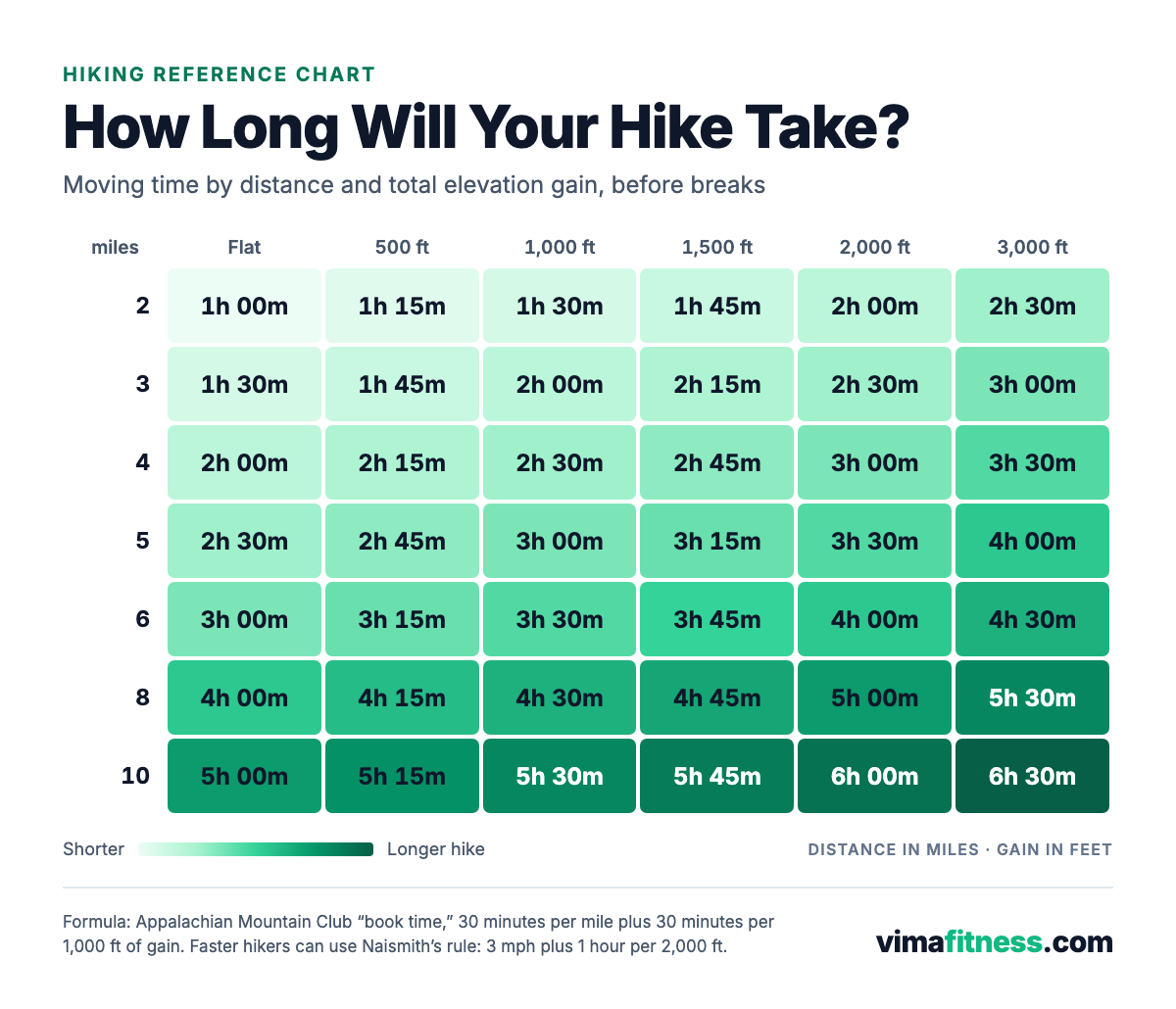
In US terms, the rule works out to 3 mph plus 1 hour per 2,000 feet of gain. Put another way, that’s 20 minutes per mile plus 30 minutes per 1,000 feet. For a 5-mile hike with 1,000 feet of gain, that’s 100 minutes of walking plus 30 minutes of climbing, or 2 hours 10 minutes.
The US version: AMC book time
Three miles an hour is brisk on a real trail, so many US hikers use a slower formula from the Appalachian Mountain Club’s White Mountain Guide, usually called book time. It allows 30 minutes per mile plus 30 minutes per 1,000 feet of elevation gain, as Michael Lanza explains at The Big Outside. That’s 2 mph plus an hour per 2,000 feet. Same climbing penalty as Naismith, slower walking pace.
For most casual hikers, book time is the more realistic starting point. Lanza adds that, in his experience, a mile of distance feels closer to 500 to 750 vertical feet of climbing than to 1,000. In other words, steep trails can take even longer than book time suggests.
Adjusting for fitness: Tranter’s corrections (and a simpler fix)
Both formulas assume an average hiker. Tranter’s corrections, created by Scottish mountaineer Phillip Tranter, adjust Naismith’s estimate for fitness, measured by how many minutes it takes you to climb 1,000 feet over half a mile. On that scale, as grough’s look at Naismith’s rule explains, 15 minutes is very fit and roughly halves Naismith’s time, while 50 is very unfit. Tranter also had you drop a fitness level for a 20 kg pack (about 44 pounds), a headwind or hiking at night, and one or two levels for rough terrain.
Few people have a 1,000-foot hill handy for testing, though. A simpler fix is your own correction factor. Time yourself on a hike with a known distance and elevation gain, then divide your actual moving time by the formula’s estimate. If book time said 3 hours and you took 3 hours 30 minutes, your factor is about 1.17. Multiply future estimates by that number.
Terrain, pack weight and what the formulas miss
Neither formula knows about rocks, roots, mud, snow or stream crossings. Two 5-mile trails can have identical stats and very different times if one is packed dirt and the other is a boulder field. Read recent trail reviews for conditions, and if the ground sounds rough, add time the way Tranter did.
Pack weight matters too. In a study of experienced female recreational hikers walking 8 km, a pack at 20% of body weight still felt fairly light, but 40% felt hard, and the researchers recommended a limit of 30% of body weight for prolonged walking. A day pack for 5 miles should be nowhere near that, which is a good argument for packing light on a day hike.
Groups also move at the pace of the slowest hiker, so plan around that person, not the fastest one. And if you’re training for a bigger hike, do practice hikes with the pack you’ll actually carry.
Going downhill isn’t free time
Naismith’s rule adds nothing for descent, and book time treats downhill like flat ground. Eric Langmuir’s classic UK handbook, Mountaincraft and Leadership, refines that: subtract 10 minutes per 300 meters (about 1,000 feet) of descent on gentle slopes, and add 10 minutes per 300 meters on steep ones. Over a full day, Langmuir says it’s normal to ignore descent entirely, since the quick gentle stretches and the slow steep ones roughly cancel out. (That’s also from the grough piece above, which is openly skeptical of the gentle slope discount.)
For a typical out-and-back 5-miler, ignoring descent is a fair assumption. Just don’t expect to fly down a steep, loose trail.
Steep descents are slow for a reason: they’re hard on your knees. In a study of downhill walking with hiking poles, poles reduced forces on the knee joint by roughly 12 to 25%. If you have knee or joint problems, check with your doctor or a physical therapist before planning hikes with a lot of descent.
Planning your turnaround time and daylight
Once you have an estimate, use it to set a turnaround time. The Appalachian Mountain Club suggests figuring out where your halfway point should be. If it takes you more than half your estimated time to get there, think about turning back.
Then work backward from sunset. Add your estimate, your breaks and a cushion of about an hour, and start early enough to finish with daylight to spare. That cushion matters most in fall and winter, when the sun sets early. It’s also why a headlamp belongs in your pack even on short hikes.
How to read trail app time estimates
Trail apps do the same math you just did. AllTrails says its estimated time uses a modified version of Naismith’s rule based on distance and elevation gain, under average conditions. So it shares the same blind spots. It doesn’t know your fitness, your breaks or how rocky the trail is. (If you’re weighing the paid features, here’s our take on whether AllTrails is worth it.)
Two habits make app estimates more useful. Compare them with your moving time, not your total time, because formula-based estimates don’t build in long stops. And treat elevation gain as approximate, since GPS elevation readings can be noisy.
The easiest way to calibrate is to record a few hikes. A GPS tracker like Hiking Tracker shows your distance, pace, time and altitude with a route map color-coded by speed, so you can see exactly where the climbs slowed you down. After three or four hikes, you’ll know your personal correction factor better than any formula does.
Frequently Asked Questions
How long does it take a beginner to hike 5 miles?
Plan on roughly 2.5 to 3.5 hours of moving time for a 5-mile trail with up to 2,000 feet of gain, based on AMC book time, plus extra for breaks. For a first 5-miler, pick a trail with modest elevation gain. Our guide to picking your first trail shows how to read difficulty ratings.
Is hiking 5 miles in 2 hours good?
On a trail with real climbing, yes. Two hours for 5 miles is a 2.5 mph average, and Naismith’s rule, which assumes a reasonably fit hiker, puts a 5-mile hike with 1,000 feet of gain at 2 hours 10 minutes. On a flat path, 2 hours is a relaxed pace.
How long does it take to hike 5 miles with 2,000 feet of elevation gain?
About 2 hours 40 minutes by Naismith’s rule and 3 hours 30 minutes by AMC book time, before breaks. With short stops, plan for around 4 hours.
How many calories does a 5-mile hike burn?
It depends mostly on your body weight, the amount of climbing and how long you’re out. Our breakdown of how many calories hiking burns has numbers by weight and trail type.
The bottom line on hiking 5 miles
Start with 2 to 3 hours for a moderate 5-mile hike. Use Naismith’s rule if you’re fit and the trail is smooth, and AMC book time if you’re an average hiker on a real trail. Then add time for steep or rocky ground, a heavy pack, a group and your breaks.
Better yet, track a few hikes and learn your own number. Once you know how your pace compares with the formulas, you’ll pick turnaround times that get you back to the car with daylight left.

Derek Clark
Co-founder of Vima Fitness. Building simple, privacy-focused fitness apps for iPhone and Apple Watch since 2011. Runner, cyclist, and firm believer that fitness apps shouldn't need a tutorial.